
Table of Contents
Know what the weather is doing on your property
Home weather stations give you something a regional forecast cannot: measurements from your own yard. Rain can miss the airport and soak your garden. A sheltered valley can frost while the nearest town stays above freezing. On a working homestead, those small differences affect irrigation, planting, livestock chores, and whether outdoor work should wait until the wind settles down.
The best home weather stations measure more than temperature. A complete system may track humidity, rainfall, barometric pressure, wind speed and direction, UV, and solar radiation. Some include a color console you can check over breakfast. Others send everything to an app and let the phone do the heavy lifting.
This guide compares five home weather stations sold on Amazon, from an approachable dual-display setup to a premium Davis system. It also explains sensor placement, internet features, expandability, and maintenance. Those details matter because an expensive sensor mounted beside a sun-baked roof can still produce expensive nonsense.
What home weather stations can tell you
A well-placed station can build a useful record of conditions on your property. Gardeners can compare rainfall with irrigation, watch overnight lows, and see whether strong wind is drying beds faster than expected. Livestock owners can monitor heat, cold, and wind near the areas animals actually use. Anyone planning outdoor work gets a better picture of what is happening at home instead of several miles away.
Home weather stations are also useful for spotting patterns. One wet afternoon is trivia. A month of rainfall totals can help explain why a low spot stays soggy or why a raised bed needs more water than last year. Temperature and humidity records can reveal how much a greenhouse, barn, or sheltered garden differs from an open part of the property.
Home weather stations do have limits. The National Weather Service explains that consumer stations are not part of an official observing network, though their data can still help forecasters monitor small-scale conditions. Your readings are local, owner-maintained observations. They should not be presented as interchangeable with an airport ASOS station or a climate reference network with redundant instruments and formal quality control.
How to choose home weather stations
Start with the job
Decide what you want to measure before comparing screens and apps. A vegetable gardener may care most about rain, overnight temperature, humidity, and optional soil sensors. A larger rural property may put more weight on wind, lightning alerts, long wireless range, and remote access. Someone who only wants indoor and outdoor temperature does not need to buy a miniature weather bureau.
Full home weather stations usually include an outdoor array and either an indoor console, an internet gateway, or both. Check what comes in the box. A product page may show optional soil probes, lightning detectors, and extra displays that are sold separately.
Compare the actual sensor package
Temperature and humidity are standard on home weather stations. Rain and wind separate full home weather stations from basic forecast displays. UV and solar radiation can be useful for gardeners, greenhouse operators, and anyone curious about how hard the sun is working on a particular day.
Rain measurement is a major dividing line among home weather stations. Many stations use a tipping bucket that collects water and tips after a set amount. The collector must remain level and clean. Other systems estimate precipitation with electronic or haptic sensing and have no bucket to empty. Fewer moving parts can mean less physical cleaning, but the measurement method is different. Do not assume two systems will report identical totals during every storm.
Wind sensors may use cups and a vane or ultrasonic measurement. Mechanical parts are easy to understand but must spin freely. Ultrasonic sensors have no cups to seize or wear, though proper exposure still matters. A fancy wind sensor behind a barn remains a fancy sensor behind a barn.
Choose between a console and an app
A dedicated console on home weather stations is easy to glance at while walking through the kitchen. It also keeps the basic station useful when your phone is elsewhere. App-based home weather stations make remote checking, alerts, graphing, and data sharing easier. The trade-off is greater dependence on Wi-Fi, cloud services, and account setup.
Some home weather stations provide both. If remote access matters, check whether the station connects directly to Wi-Fi, needs a separate gateway, or uploads through a console. Look at export options too. Years of data are more useful when you can download them rather than admire one attractive graph at a time.
Think about expandability
Extra indoor temperature and humidity sensors can monitor a greenhouse, barn, basement, seed-starting room, or food-storage area. Soil-moisture sensors can add another layer to irrigation decisions. Leak and lightning sensors may fit properties with pumps, outbuildings, or exposed work areas.
Expandable home weather stations cost more once the accessories begin multiplying, so make a realistic list. Buying an ecosystem for eight future sensors is not a bargain if all eight remain in your online wish list until retirement.
Check power, wireless range, and internet needs
Outdoor arrays often use a small solar panel with battery backup. Indoor consoles typically need an outlet, sometimes with batteries for short outages. Read the power details carefully because “solar powered” may describe only the outdoor sensor.
Manufacturers of home weather stations list wireless ranges under favorable conditions. Walls, metal siding, trees, terrain, and outbuildings can shorten them. Mount the array where it has good exposure and a reliable path to the console or hub. If the station depends on Wi-Fi for remote access, confirm that your network reaches the gateway location before installing anything on a pole.
Sensor placement matters more than the prettiest display
The hardest part of installing home weather stations is that each sensor wants a different location. Temperature and humidity readings are best near human height over representative natural ground. Wind measurements are more comparable when the anemometer is high and clear of obstructions. Rain gauges need to be level, accessible, and protected from splash without being hidden beneath trees.
For home weather stations, the National Weather Service siting guide recommends a ventilated radiation shield for temperature and humidity, positioned roughly four to six and a half feet above the ground. Dark roofs, pavement, walls, air conditioners, and heavily irrigated patches can bias the reading. The sensor should represent the area you care about rather than the hottest convenient mounting surface.
Wind is tougher for home weather stations. The standard comparison height is about 10 meters, or 33 feet, with generous clearance from trees and buildings. Most homesteads will not erect a dedicated meteorological tower. That is fine, but recognize the compromise. A lower anemometer can still show useful gusts and trends while reporting lower wind speeds than a standard open exposure.
Rain gauges need open sky and a level collector. Cornell NEWA’s placement guide warns that buildings and isolated trees create turbulence that can deflect rain, while an exposed rooftop may be so windy that the gauge undercatches precipitation. Keep the collector away from surfaces that splash water into it and mount it where you can safely clean out leaves, pollen, nests, and the occasional ambitious spider.
Most consumer home weather stations combine all the outdoor sensors into one array. That keeps installation simple but prevents perfect placement for every measurement. Choose the best practical site, record the mounting height and nearby obstructions, and interpret the data accordingly. Consistent imperfect exposure is often more useful than moving the array every month in pursuit of laboratory purity.
Top 5 home weather stations
1. Ambient Weather WS-2902 — best overall
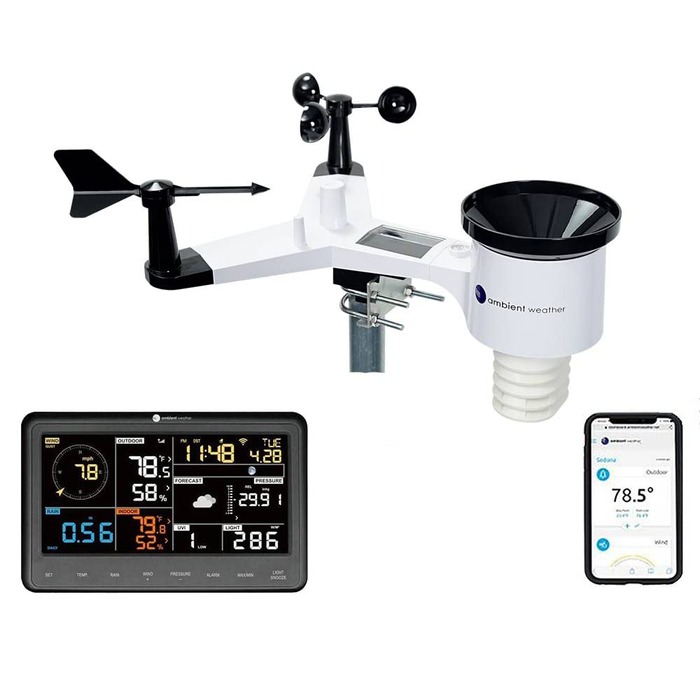
The Ambient Weather WS-2902 is the best overall choice for readers who want a complete sensor array, a color console, and internet access without jumping straight to the premium end of the category. Its outdoor array measures temperature, humidity, wind speed and direction, rainfall, UV intensity, and solar radiation.
These home weather stations send local readings to the indoor display and can upload data through Wi-Fi for remote viewing and alerts. That combination works well for a garden or mixed-use homestead. You can check the console during breakfast, then look at the same property data from a phone while away.
The integrated Osprey array simplifies installation, but the usual siting compromise applies. Mounting it high improves wind exposure while moving the temperature sensor and rain collector away from their preferred heights. Pick the measurement that matters most, choose the best available open site, and keep the array reachable enough to clean the rain cup.
Ambient also supports online dashboards and smart-home connections. Treat those as conveniences rather than the reason to buy the station. The useful part is the broad sensor package and the ability to view it both locally and remotely.
Key Advantages
- Complete array measures rain, wind, temperature, humidity, UV, and solar radiation
- Color console plus Wi-Fi remote monitoring
- Custom alerts and online data access
- Strong general-purpose fit for gardens and rural properties
2. AcuRite Iris 01078M — best dual-display station
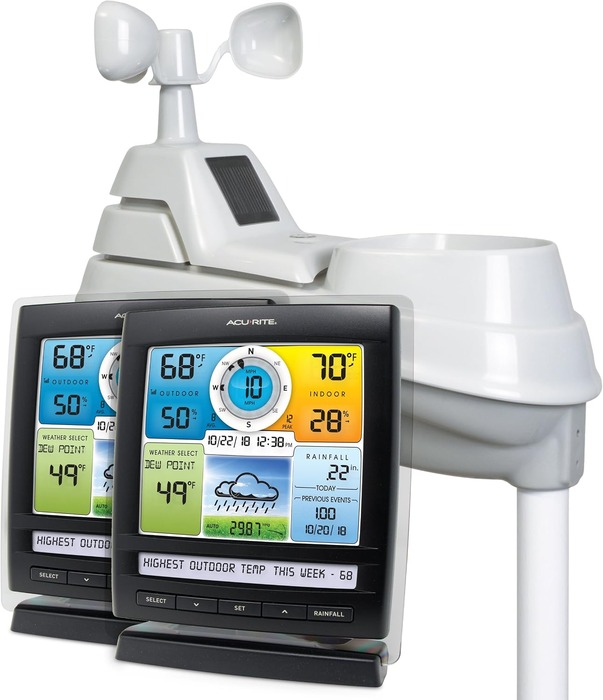
The AcuRite Iris 01078M is built for people who would rather read the weather from a screen than open an app. It includes two color displays, so you can keep one in the house and another in a workshop, office, or mudroom. The outdoor five-in-one sensor tracks temperature, humidity, wind speed, wind direction, and rainfall.
Among full home weather stations, the second display is a genuinely useful distinction. Many competing packages provide one console or no console. Two displays let different parts of the household see the same outdoor conditions without passing a phone around like a ceremonial object.
The weather ticker also shows derived information such as heat index, wind chill, and indoor comfort. The displays use household power and allow battery backup. This configuration focuses on local viewing rather than the larger remote-monitoring ecosystem offered by the Ambient, ECOWITT, and Tempest picks.
Choose the AcuRite when reliable glanceable displays matter more than integrations and accessory expansion. The sensor array still needs good exposure, and its rain collector still needs routine cleaning and leveling.
Key Advantages
- Two included color displays for separate rooms
- Five-in-one sensor tracks temperature, humidity, wind, and rainfall
- Adjustable display brightness and weather ticker
- Battery-backup option for the indoor displays
3. ECOWITT WS3801 — best expandable system
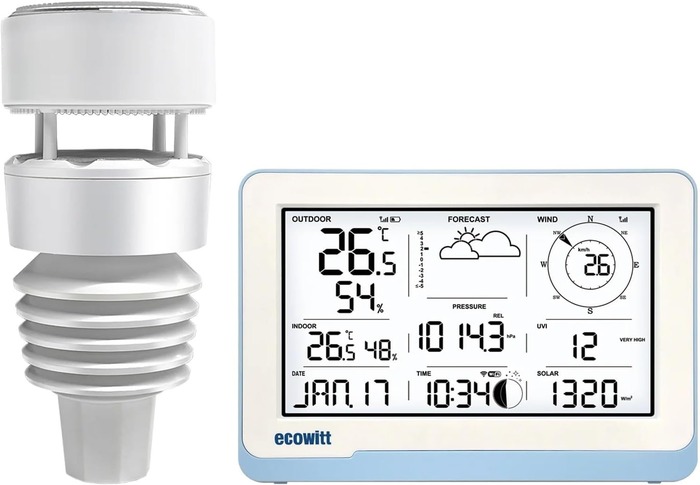
The ECOWITT WS3801 is the pick for readers who want weather monitoring to grow into a broader property-sensor network. The package combines a WS90 seven-in-one outdoor array with a 7.5-inch WS3800 display console. It tracks temperature, humidity, wind speed and direction, light, UV, and rainfall.
What separates these home weather stations is the accessory ecosystem. The listing describes support for optional soil-moisture probes, additional temperature and humidity sensors, lightning detection, air-quality monitors, water-leak detectors, and leaf-wetness sensors. A gardener could start with weather data, then add soil monitoring in key beds or temperature sensors in a greenhouse and outbuilding.
The console connects through 2.4 GHz Wi-Fi and can upload readings to ECOWITT and compatible weather services. This is useful for remote access and longer-term records, though it also adds setup. Keep the manual. Label the sensors. Future you has enough chores without wondering which anonymous channel belongs to the greenhouse.
The WS90 uses electronic wind and rainfall sensing rather than a conventional cup anemometer and tipping bucket. That reduces moving parts, but the methods are not identical. Compare trends against a manual rain gauge during the first few storms if rainfall totals will guide important irrigation decisions.
Key Advantages
- Seven-in-one outdoor array with a large console
- Broad optional-sensor ecosystem
- Supports soil, greenhouse, leak, lightning, and air-quality monitoring
- Wi-Fi uploads and remote data access
4. Tempest Weather Station — best app-first design
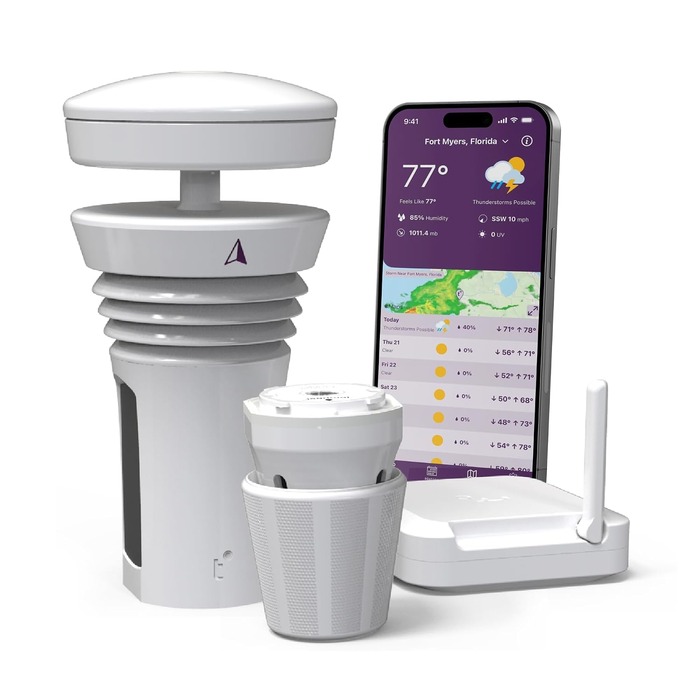
Tempest takes a different approach from console-based home weather stations. Its solar-powered outdoor device sends readings to an app rather than an included tabletop display. The unit measures temperature, humidity, barometric pressure, wind speed and direction, dew point, solar radiation, UV, lightning activity, and rainfall.
There are no conventional spinning cups or tipping rain bucket. The listing describes rapid updates, long wireless range, app access, alerts, and voice-assistant support. The clean one-piece design is attractive when you want fewer exposed moving parts and do not mind using a phone or tablet as the main dashboard.
The lack of a console is the main trade-off. Internet and app features are central to the experience, so Tempest is a weaker fit for anyone who wants the station to remain fully glanceable during a router outage. It is a stronger fit for readers who care about remote alerts, smart irrigation connections, or viewing conditions away from home.
Lightning detection adds useful awareness, but it is not a substitute for official warnings. Use National Weather Service alerts and safe shelter decisions during severe weather. A backyard sensor can add local context; it does not get the final vote when thunder is close.
Key Advantages
- Solar-powered all-in-one outdoor sensor
- No conventional moving wind or rain parts
- Measures lightning activity, UV, solar radiation, wind, rain, and core weather data
- Strong app, alert, and smart-home focus
5. Davis Instruments Vantage Vue — best premium station
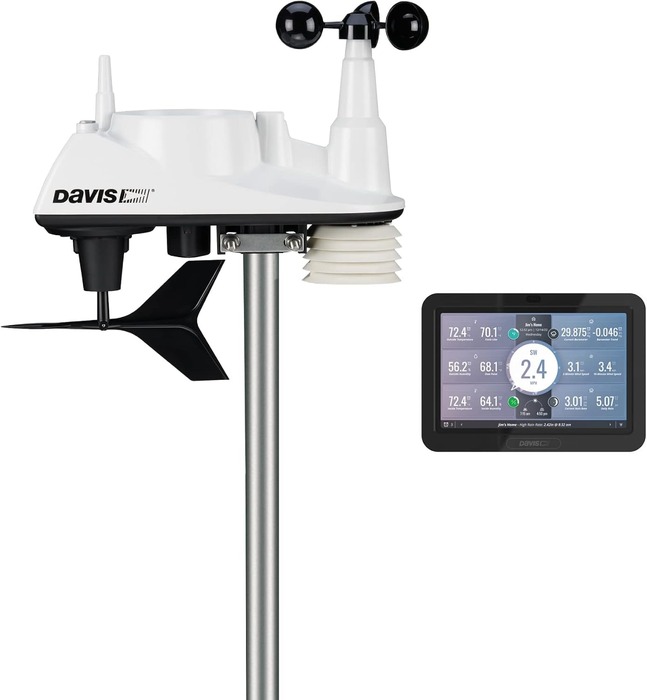
The Davis Instruments Vantage Vue is the premium choice for a reader who wants fast updates, a dedicated touchscreen console, and a system built around ongoing weather records. The integrated suite measures outdoor temperature and humidity, wind, rainfall, barometric pressure, dew point, and wind chill. The WeatherLink console adds indoor readings, forecasts, alarms, and cloud access.
Davis lists updates as fast as 2.5 seconds and wireless transmission up to 1,000 feet under suitable conditions. Those are manufacturer specifications, not promises that the signal will sail through every metal barn and wooded hillside. Home weather stations should be planned around the real property, not the clean empty field pictured in your imagination.
The outdoor suite uses solar power with battery backup, while the console uses AC power with battery backup. Its fast local display and WeatherLink access suit people who want both an always-visible console and connected records.
The drawback is cost. The Vantage Vue makes sense when weather data is a serious long-term tool for the property. If you mainly want rainfall totals and tomorrow morning’s low, the Ambient or AcuRite will do the job with less financial weather.
Key Advantages
- Fast listed update interval and long listed wireless range
- Dedicated WeatherLink touchscreen console
- Solar-powered sensor suite with battery backup
- Local display, alarms, historical data, and cloud access
Keep home weather stations accurate
Installation day is only the beginning for home weather stations. Check home weather stations after strong wind, heavy rain, snow, nearby mowing, or any event that may tilt the mount or pack debris into the collector. A loose pole changes wind direction. A clogged rain funnel reports a drought that exists only inside the gauge.
Cornell NEWA’s maintenance guide recommends regular inspection for dirt, nests, plant debris, loose fasteners, damaged cables, and free movement of mechanical sensors. Clean a tipping-bucket gauge at least once or twice a year, and more often near trees, orchards, heavy pollen, or enthusiastic insects.
Compare temperature and humidity with a trustworthy reference occasionally. Watch for sudden shifts that do not appear at nearby stations. Confirm that a mechanical anemometer spins in light wind and that the direction reference still points to true north after the mount is moved.
Home weather stations with app dashboards can make bad readings look impressively polished. Graphs are useful, but they cannot detect every clogged funnel or sun-heated sensor. A quick physical inspection remains part of owning the equipment.
Keep notes on installation height, nearby obstructions, maintenance, battery changes, and sensor replacements. Those details help explain changes in the record. If the station moves from beside a shed to an open garden pole, the data before and after the move should not be treated as though the exposure stayed identical.
Which home weather station should you choose?
The Ambient Weather WS-2902 is the strongest all-around recommendation. It covers the measurements most homesteads want, includes a console, and adds remote monitoring without requiring a premium budget.
Choose the AcuRite Iris when two easy-to-read displays matter more than a deep online ecosystem. The ECOWITT WS3801 is better for a garden or rural property that may eventually add soil, greenhouse, leak, or lightning sensors. Tempest suits app-first users who want electronic wind and rain sensing without conventional moving parts.
The Davis Vantage Vue is the premium pick for readers who expect to use local weather records for years and want rapid updates, a dedicated touchscreen, and WeatherLink access. Whichever model you choose, give installation as much thought as the product. Properly placed midrange home weather stations can produce more useful data than premium equipment mounted in a convenient bad spot.
Put local weather data to work
Rainfall records are most useful when paired with soil conditions and actual plant needs. Our guide to the best drip irrigation kits for raised beds covers practical ways to deliver water once you know the garden needs it.
Readers building independent power and monitoring systems can compare the best portable solar panels. Check each station’s electrical requirements before pairing equipment; a solar-powered outdoor sensor does not mean its indoor console or internet router needs no power.
For broader outage planning, see the best gas-powered generators for home backup. A weather station draws little power, but remote monitoring may still disappear when the router, modem, or console loses electricity.
Amazon Disclosure
As an Amazon Associate I earn from qualifying purchases.