
Table of Contents
Keep the flock drinking when temperatures drop
Heated chicken waterers solve one of winter’s most repetitive coop chores: breaking ice and swapping frozen containers before the flock can drink. Chickens need reliable access to fresh water even when the run is frosty, the hose is stiff, and you would rather remain indoors with coffee. A good heated setup keeps water available without turning the coop into an electrical science project.
The best heated chicken waterers use a thermostat to run the heating element only when conditions call for it. Some use recessed nipples that help keep bedding and manure out of the reservoir. Others use a familiar open trough for birds that never received the nipple-drinker memo. A heated base is another option if you already own a compatible poultry fount.
This guide compares five heated chicken waterers and winter-water solutions sold on Amazon. We looked at capacity, wattage, drinking style, refill access, cord design, placement, and which flock each product suits. We also cover safe setup and daily checks, because heated chicken waterers reduce ice duty but don’t eliminate animal care.
The most useful heated chicken waterers are not necessarily the largest or most powerful. They are the models your birds will use reliably and you can refill, clean, and power safely throughout winter.
Why chickens still need daily water checks in winter
Cold weather does not make water optional. The University of Minnesota Extension recommends checking and refreshing chicken water routinely and keeping a second waterer available in case the first freezes or fails. Heated chicken waterers make that routine easier, but you still need to verify that the reservoir contains water and every drinking point works.
A unit can have power while a nipple is blocked. An open trough can collect bedding. A cord can come loose, a breaker can trip, or a lid can freeze in place. The useful habit is simple: look at the waterer when you open the coop, test its drinking points, and watch that the birds are actually using it.
Keep a spare unheated waterer ready for outages and cleanup days. If the main unit fails, you can carry fresh water out while troubleshooting instead of leaving the flock thirsty. Heated chicken waterers are tools, not tiny plastic farmhands.
Nipple drinkers or open troughs?
Nipple-style heated chicken waterers keep most of the stored water enclosed. That helps reduce contamination from scratching, bedding, droppings, and the chicken who considers every clean surface a personal challenge. Horizontal nipples can also limit spills when the birds know how to use them.
The catch is training. Chickens accustomed to an open pan or fountain may not immediately understand a nipple system. Introduce the new waterer before freezing weather, show the birds how the nipple releases water, and confirm that several flock members use it. Do not remove their familiar source until the new system is clearly working for them.
Open-trough heated chicken waterers are easier for most birds to recognize. They can suit mixed-age flocks or chickens that refuse nipple training. They also expose more water to dirt and may need more frequent cleaning. A raised, stable position helps keep bedding out without making the trough difficult to reach.
Ducks complicate the decision. Ducks need enough water to clean their nostrils and often benefit from a separate source that lets them submerge their bills or heads. A nipple waterer may supply drinking water, but you shouldn’t treat it as their only water source.
How to choose heated chicken waterers
Match capacity to the flock
A two-gallon unit may be plenty for a small backyard flock if you refill it regularly. A three-gallon model gives more breathing room for additional birds or longer intervals between refills. Manufacturer bird-count claims are rough guides, not refill schedules. Weather, bird size, diet, spillage, and flock habits all affect consumption.
Larger is not always better. Water weighs a little over eight pounds per gallon, so a full three-gallon waterer is not dainty. Consider where you will fill it, how far you must carry it, and whether the handle and hanging point can support the load.
Capacity also determines how often heated chicken waterers need attention. A larger reservoir may reduce refill trips, but it still needs a daily inspection for leaks, contamination, and blocked drinking points.
Compare thermostats and wattage
Most heated chicken waterers use a thermostat that turns the element on near freezing and off when heating isn’t needed. That saves electricity compared with an element that runs constantly. Wattage can give you a rough sense of heater size, but higher wattage does not guarantee better performance in every coop.
A manufacturer’s minimum-temperature claim depends on placement, wind, refill temperature, power reliability, and the waterer’s condition. Treat the number as a listed capability rather than a promise for your exact winter.
Look at refill access
Top-fill caps are handy when the lid or base is difficult to separate in cold weather. Removable lids provide better access for scrubbing. Traditional fountains may need to be flipped or inverted during filling, which gets old when the container is heavy and the ground is icy.
Choose heated chicken waterers you can clean without a wrestling match. Algae and residue do not take winter off, and enclosed nipple systems still need periodic flushing.
Plan the cord route before buying
The cord needs a protected path to an appropriate power source. Chickens should not be able to peck the cable or stand on the connection. Keep plugs and extension connections dry, elevated, and protected, per the product instructions.
Illinois Extension advises keeping electrical cords and connections off the floor and out of reach of chickens when using heated waterers or bowls. Use outdoor-rated electrical equipment and GFCI protection where required. If the coop has no safe power route, running a random indoor extension cord through wet bedding is not Plan B.
Check placement and stability
Some heated chicken waterers can hang, while others sit on a stand or heated base. Hanging helps reduce kicked-in bedding, but the support must handle the full weight. Ground units need a flat, stable platform that will not wobble when several birds drink at once.
Keep the waterer out of the roost’s drop zone. This sounds obvious until you remember that chickens are gifted at finding the least convenient place to produce fertilizer.
Top 5 heated chicken waterers
1. Premier 1 All-Season Heated Poultry Waterer — best premium pick
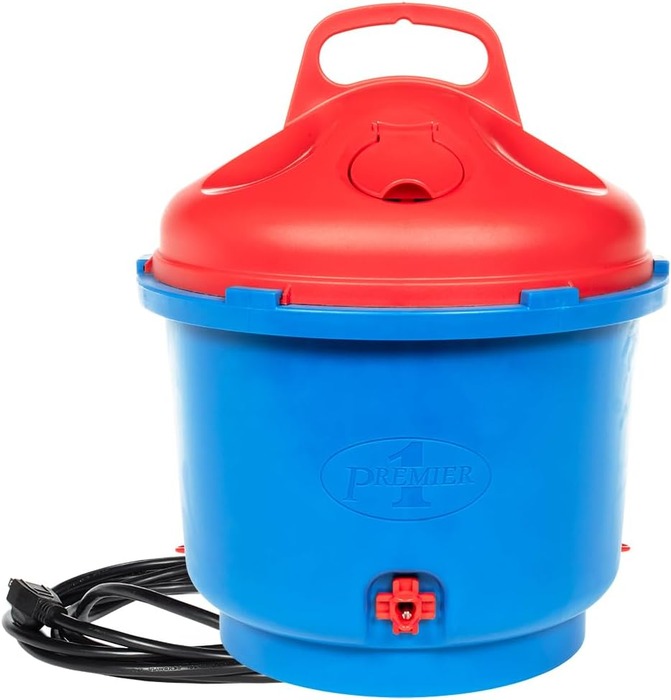
The Premier 1 All-Season model is the most complete premium option in this group. It combines a three-gallon reservoir with three recessed horizontal nipples, a heavy-duty carrying and hanging handle, and a 100-watt thermostatic heating element. Premier 1 lists the unit for up to 35 adult chickens, but your refill routine should be based on actual flock use.
Its hinged quick-fill cap is the clever bit. You can add water with a hose or watering can without removing the insulated lid, which can help when cold weather makes plastic parts stubborn. The main lid still comes off for cleaning.
The 16-foot electrical cord detaches for warm-weather use, making this one of the few heated chicken waterers that transitions neatly through all four seasons. Premier 1 states that the thermostat turns the heater on below 40°F and off at 60°F. The company also lists freeze protection to -20°F; treat that as the manufacturer’s claim rather than an independent field test for every coop.
Birds need to understand nipple drinkers before you rely on this unit. For ducks, Premier 1 recommends another water source so they can submerge their heads.
Key Advantages
- Three-gallon reservoir with three recessed nipples
- Hinged quick-fill cap for cold-weather refills
- Detachable 16-foot cord for nonwinter use
- Hanging handle and thermostatic 100-watt heater
2. Farm Innovators HB-60P — best value nipple waterer
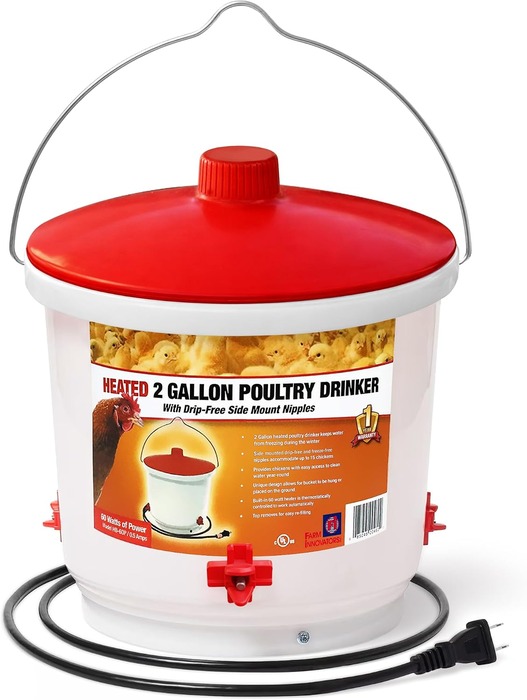
The Farm Innovators HB-60P is a practical choice for smaller flocks that already use horizontal nipples. Its two-gallon container has side-mounted drinking nipples and a 60-watt thermostatically controlled heater. Farm Innovators lists it for up to 15 chickens.
You can hang the waterer by its metal handle or place it on a stable surface. The top removes for refilling and cleaning, which is simpler than inverting a full traditional fountain. The enclosed reservoir also keeps most bedding and debris away from the water supply.
Among heated chicken waterers, this model lands in a useful middle ground: enough capacity for a typical backyard flock without the bulk of a larger bucket. The two-gallon size is easier to carry when full, and the thermostat runs the heating element only when needed.
The HB-60P is not the best first nipple waterer to introduce during a blizzard. Train the flock while temperatures are mild, verify that every bird can trigger the nipples, and keep a backup source available during the changeover.
Nipple-style heated chicken waterers are especially useful where wet bedding is a recurring winter problem. Their value depends on every bird understanding the drinking mechanism before freezing weather arrives.
Key Advantages
- Two-gallon capacity for small and medium flocks
- Side-mounted nipples help keep stored water clean
- 60-watt thermostatically controlled heater
- Can hang or sit on a stable platform
3. K&H Thermo-Poultry Waterer — best open-trough design
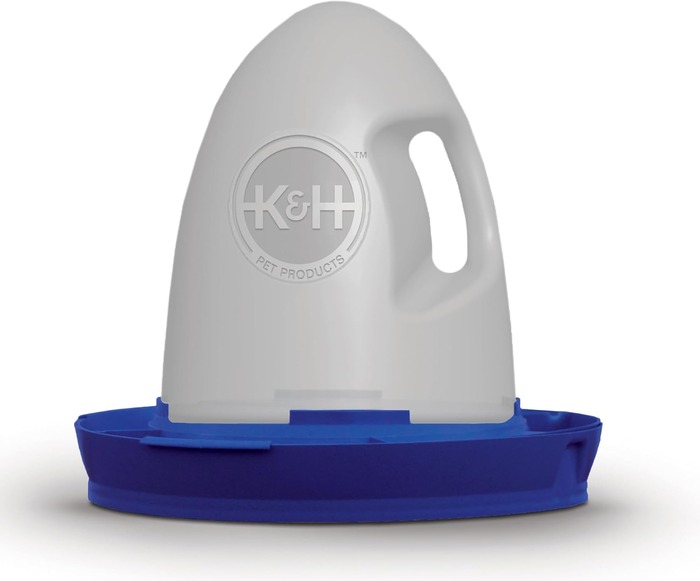
The K&H Thermo-Poultry Waterer suits birds that prefer a familiar open drinking trough. Its 2.5-gallon tank feeds water into a circular base, while a 60-watt thermostatic heater helps keep the drinking area ice-free. The sloped top discourages roosting, an underrated feature when cleanliness matters.
A spill-resistant cap makes the tank easier to carry and return to the base after filling. K&H also includes a removable filter ring intended to catch debris before it settles into the trough. You still need to rinse the drinking channel regularly, but the filter gives feathers and bedding somewhere else to go.
Open-trough heated chicken waterers are easy for most chickens to recognize, so this model avoids the training step that comes with nipples. The trade-off is exposure. Dirt can enter the trough, and an uneven base can cause uneven water flow or spills.
Place the K&H on a firm, raised stand, keep it clear of the roost, and check the trough daily. It suits owners who value familiar drinking access over a fully enclosed system.
Among open-trough heated chicken waterers, this design offers a practical balance between easy access and controlled water exposure. The debris filter helps, but it does not replace regular cleaning.
Key Advantages
- Familiar open trough for birds that do not use nipples
- 2.5-gallon tank with a 60-watt thermostatic heater
- Sloped no-roost top
- Spill-resistant refill cap and removable debris filter
4. Farm Innovators HPF-100 — best traditional heated fountain
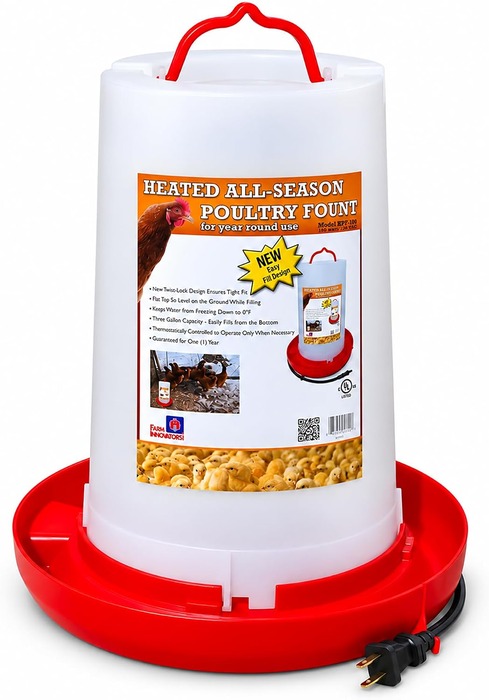
The Farm Innovators HPF-100 keeps the classic poultry-fountain design and adds thermostatic heat. Its three-gallon plastic reservoir provides an open drinking ring around the base, so chickens that already know standard gravity fountains should adapt with little drama.
The unit can hang from a suitable support, which helps keep the trough above the worst of the bedding. Farm Innovators states that the heater operates only when needed and is designed to prevent freezing down to 0°F. Conditions in an exposed run can differ, so the daily ice check remains firmly on the chore list.
This model offers more capacity than the HB-60P and avoids nipple training. It also shares the usual drawbacks of open-trough heated chicken waterers: the ring can collect dirt, a tilted fountain may leak, and filling a larger gravity reservoir takes more handling.
Choose the HPF-100 when your flock accepts traditional fountains and you want the same drinking style through winter. Traditional-style heated chicken waterers still need a level base and daily trough checks. Put this one on a level surface or hang it exactly as the manufacturer directs.
Key Advantages
- Three-gallon capacity
- Familiar open-trough fountain design
- Thermostatically controlled heating
- Hanging option helps limit kicked-in bedding
5. Harris Farms Heated Poultry Drinker Base — best conversion option
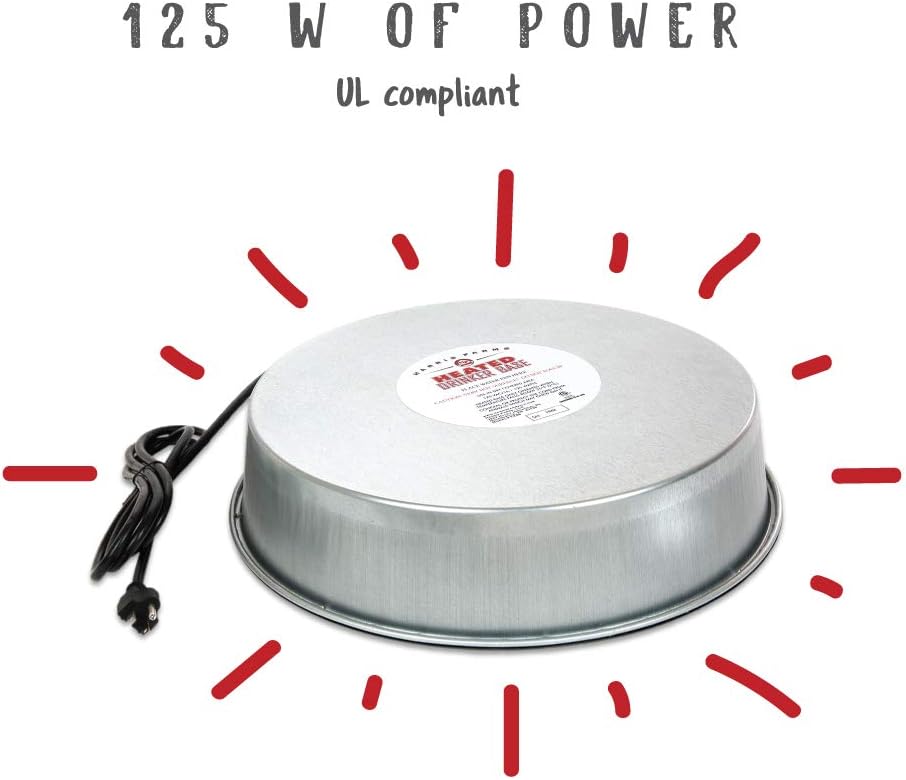
The Harris Farms Heated Poultry Drinker Base is the odd one out because it is not a complete waterer. It sits beneath a compatible poultry drinker and supplies thermostatic heat, which can save money if you already own a suitable metal or plastic fount.
Harris Farms lists the base at 125 watts and states that it turns on automatically as needed. The listing says it can be used indoors or outdoors in a dry, covered area and is designed to prevent freezing down to 10°F. Check compatibility with your exact drinker rather than balancing the nearest bucket on top and declaring victory.
A conversion base makes cleaning and replacement flexible because the reservoir remains separate from the heater. You can rotate compatible founts while you wash one. On the other hand, the setup has two components to place securely, and an unstable or mismatched container can spill.
Unlike complete heated chicken waterers, this base lets you keep using a compatible drinker you may already own. That flexibility is useful only when the container fits correctly, and the installation follows the manufacturer’s restrictions.
This is the best alternative to complete heated chicken waterers when your existing drinker fits the manufacturer’s requirements. Measure the base, check the waterer’s material and footprint, and follow both sets of instructions.
Key Advantages
- Reuses a compatible existing poultry drinker
- 125-watt thermostatically controlled base
- Suitable for specified metal and plastic drinkers
- Allows the water container to be removed separately for cleaning
Safe setup for heated chicken waterers
Install heated chicken waterers according to the manufacturer’s instructions before the first hard freeze. Use a stable, dry location protected from direct precipitation and heavy wind. If the unit hangs, confirm that the support can handle the filled weight without sagging or swinging.
Route the cord where chickens cannot peck it, and people cannot trip over it. Keep every connection elevated and dry. Do not use a frayed cord, loose plug, damaged heater, or extension cord that is not rated for the location and electrical load. A GFCI-protected supply adds important protection around water; follow local electrical requirements and the product manual.
Check heated chicken waterers at least daily. Touch or operate each nipple, inspect open troughs for ice, and make sure the reservoir has not leaked into the bedding. Wet litter in a closed coop creates its own winter problems, so fix drips rather than adding another layer of shavings and hoping nobody notices.
Clean the unit on a regular schedule. Disconnect power before taking it apart or washing it, and never submerge electrical parts unless the manual explicitly says they are designed for it. Mineral deposits can affect valves and nipples, especially with hard well water.
Heated chicken waterers with removable lids are generally easier to scrub and rinse. Whatever the design, cleaning should include the reservoir, drinking ports, seals, and any filter or trough that collects debris.
Keep a spare waterer ready. Heated chicken waterers depend on electricity, thermostats, and small moving drinking parts. A backup container turns a failure into a quick swap instead of a midwinter emergency.
Which heated chicken waterer should you choose?
The Premier 1 All-Season is the strongest premium choice for a medium flock already comfortable with nipples. Its quick-fill cap, three-gallon capacity, detachable cord, and recessed drinkers make winter refills cleaner and summer storage simpler.
The Farm Innovators HB-60P is the better value for smaller nipple-trained flocks. Choose the K&H Thermo-Poultry Waterer when your birds need an open trough and you want a no-roost top. The Farm Innovators HPF-100 is the straightforward choice for anyone who prefers a traditional hanging fountain with more capacity.
The Harris Farms base makes sense when you already own a compatible poultry drinker and would rather add heat than replace the whole system. It is also easier to rotate separate founts for cleaning.
Whichever design you choose, buy before the first freeze so the birds have time to adapt. The best heated chicken waterers save labor because they match the flock’s drinking habits, the coop’s power setup, and the owner’s willingness to clean them. Winter equipment works better when it is not introduced during the storm that made you need it.
For most backyard flocks, heated chicken waterers are worth buying before winter rather than after the first frozen morning. Early setup leaves time to train the birds, protect the cord, and correct any leaks while the weather is still cooperative.
More self-sufficiency guides
A heated waterer still stops working during an outage. For broader backup planning, compare the best gas-powered generators for home and emergency use. Confirm the generator, circuit, cord, and waterer requirements before connecting any equipment.
Readers building a wider off-grid power kit can also review the best portable solar panels. A solar panel is not a direct plug-in replacement for a safe, properly sized winter power system, but the guide explains useful portable charging options.
Amazon Disclosure
As an Amazon Associate, I earn from qualifying purchases.