
Table of Contents
Clear winter snow without maintaining another gas engine
Electric snow blowers have grown well beyond the small corded machines once reserved for patios. Today’s choices range from compact battery snow shovels to self-propelled two-stage machines built for deep snow and long driveways. That gives homesteaders useful alternatives to gasoline, but it also makes choosing the right machine more complicated.
The best electric snow blowers are not simply the models with the largest voltage number or the longest advertised throwing distance. Surface type, driveway length, typical snow depth, wet versus powdery snow, slopes, battery capacity, and access to outdoor power all matter. A light cordless machine can be a delight on a paved walkway and a poor joke at the end of a gravel lane buried by a county plow.
This guide compares five electric snow blowers sold on Amazon, including corded, cordless, compact, single-stage, and two-stage options. It also explains where each design fits, which specifications deserve attention, and how to operate electric snow-removal equipment without feeding gloves, gravel, or extension cords to the auger.
Match the machine to the property
Before comparing electric snow blowers, look at the work waiting outside. Measure the driveway or paths you actually need to clear. Note whether the surface is smooth pavement, rough concrete, decking, pavers, or loose gravel. Consider the ordinary storm rather than the once-in-a-decade blizzard, but do not forget the dense ridge left by a road plow.
Electric snow shovels
An electric snow shovel is the smallest option. These narrow machines are useful on steps, decks, short walkways, and the path between the house and an outbuilding. They are easier to store than full-size electric snow blowers and can be convenient for quick cleanup after a light storm.
The trade-off is capacity and control. A snow shovel generally has a narrow intake, limited depth, and little or no self-propulsion. Some throw snow mainly forward, while others include an adjustable chute. They are not the right primary tool for a long rural driveway, deep drifting, or the compacted wall at the roadside.
Compared with full-size electric snow blowers, snow shovels are better treated as access tools than driveway machines.
Single-stage electric snow blowers
Single-stage electric snow blowers use one rotating auger to gather snow and throw it through the chute. Their paddles often clean close to a hard surface, which makes them effective on paved driveways and sidewalks. They tend to be lighter, easier to maneuver, and less expensive than two-stage equipment.
That close-running auger is also why many single-stage models should not be used on gravel. Loose stones can enter the housing and become projectiles. Greenworks specifically says its single-stage snow throwers and snow shovels are not recommended for gravel. Always follow the manual for the exact model rather than assuming that large wheels turn a pavement machine into a gravel machine.
Among electric snow blowers, single-stage models make the most sense where close pavement cleaning and easy maneuvering matter more than ground clearance.
Two-stage electric snow blowers
Two-stage electric snow blowers use an auger to collect snow and a separate impeller to discharge it. They are the serious option for deeper accumulations, packed plow berms, longer drives, and surfaces that require more ground clearance. Self-propelled drive is especially valuable when the machine itself is heavy or the property has a grade.
A two-stage machine with adjustable skid shoes may be suitable for gravel when set up according to its manual. That does not make every loose driveway safe, nor does it make every slope manageable. Ruts, hidden rocks, ice, and steep cross-slopes still demand caution. The machine should fit both the snow and the person controlling it.
Corded or battery-powered?
Corded electric snow blowers offer continuous power without waiting for a battery to recharge. They can be a sensible value on a short, flat paved driveway close to a correctly protected outlet. They also require constant cord management. The operator must keep the extension cord behind the machine, out of the clearing path, and away from the auger.
Use only an extension cord approved for outdoor cold-weather service and sized for the machine’s amperage and the full cord length. The product manual controls the required gauge and maximum length. A thin household cord, damaged insulation, a wet connection, or a string of daisy-chained cords is not a thrifty workaround; it is an electrical problem wearing winter boots.
Battery electric snow blowers remove the cord but introduce limits of their own. Runtime changes with battery capacity, snow depth, snow density, temperature, pace, and the number of starts and turns. Manufacturer driveway-size claims are useful comparison points, not promises for every storm. Wet snow and plow-packed debris require far more work than dry powder.
Battery temperature matters too. Greenworks advises storing batteries at room temperature for best starting performance, while EGO specifies temperature ranges for charging and long-term storage in its battery manual. Keep packs dry, charge them within the manufacturer’s permitted range, and let a very cold pack warm naturally indoors before charging if the manual requires it. Do not put lithium-ion batteries beside a heater in an attempt to hurry winter along.
For battery electric snow blowers, a second warm, charged pack can be more useful than an optimistic runtime estimate.
What to compare before buying
Clearing width and intake height
Wider electric snow blowers clear more ground per pass, but width is not the same as storm capacity. Intake height indicates what can physically enter the housing; it does not guarantee the machine will comfortably process snow at that full depth. Dense, wet, or refrozen snow often requires narrower bites and a slower pace.
A compact 16-inch machine can be easier to guide between raised beds, vehicles, gates, and outbuildings. A 24-inch two-stage model can save time on an open driveway but needs more storage and turning room. Measure your tightest passage before buying a machine that fits the main drive and nowhere else.
Surface and auger design
Rubber-tipped paddles can clean pavement closely. Steel augers and two-stage systems are better suited to breaking up dense snow, but they can still damage surfaces or launch debris when used incorrectly. For gravel, look for a model whose manual permits loose-surface use and explains how to set skid shoes or scraper clearance.
Electric snow blowers cannot identify newspapers, dog toys, chains, extension cords, landscape edging, or frozen garden hoses. Inspect the route before snowfall when possible and again before starting. Mark driveway edges, drains, and obstacles with stakes tall enough to remain visible.
Battery package and tool ecosystem
Check whether the listing includes batteries and a charger. Tool-only electric snow blowers can look attractive until two high-capacity packs and a charger join the cart. Existing batteries may reduce the cost, but only if their voltage, model, capacity, and required pairings are compatible.
Also ask whether the included capacity matches the property. A small battery may be adequate for a walkway and short paved drive. A long rural lane may require larger packs, a second set, or a machine from another class. Store batteries where they remain dry and within the manufacturer’s recommended temperature range.
Controls, propulsion, and storage
Chute controls should be reachable with winter gloves. Variable auger speed can help control throwing distance near buildings and vehicles. Headlights are useful for early chores, though they do not replace a clear view of the work area.
Self-propulsion matters on large two-stage electric snow blowers, grades, and dense snow. Lighter single-stage machines often rely on the auger’s contact with the pavement to help pull forward. Folding handles save storage space, but record the machine’s actual folded dimensions if it must share a shed with feed bins, garden tools, and every lumber offcut that has achieved sentimental value.
Top 5 electric snow blowers
1. EGO POWER+ SNT2114 — best overall cordless package
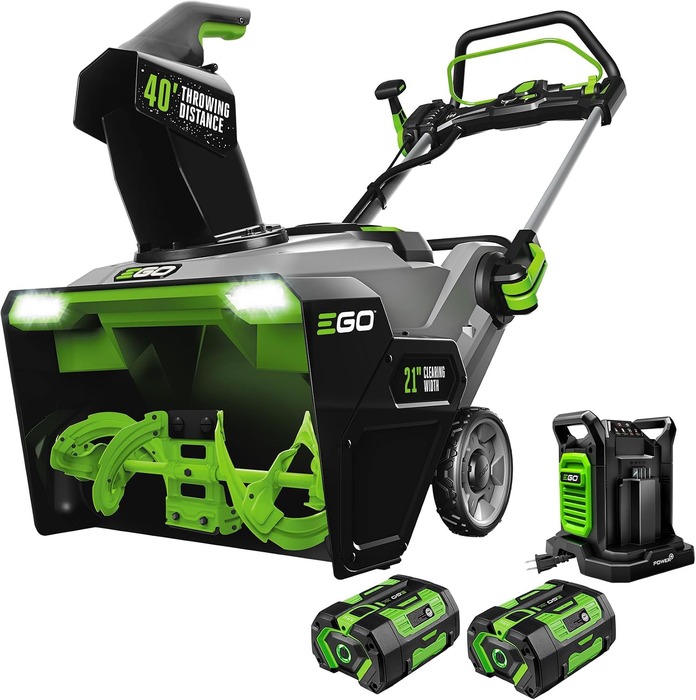
The EGO POWER+ SNT2114 is the best overall choice among these electric snow blowers for a paved medium-to-large driveway. It combines a 21-inch clearing width, steel auger, brushless motor, and handle-mounted chute control with a complete battery package. The verified listing includes two 56V 7.5Ah batteries and a dual-port charger.
EGO lists a throwing distance up to 40 feet and says the two included batteries can clear a 16-car driveway with eight inches of snow under its test conditions. Treat both as comparative manufacturer claims. Real results change with wet snow, packed berms, temperature, battery age, and the speed at which you feed the auger.
The steel auger gives this single-stage machine more bite than a lightweight rubber-paddle model. Its folding handle also makes storage less awkward. It remains a single-stage snow blower, however, so it is best matched to firm paved surfaces rather than a loose gravel lane.
Choose this model when you want cordless convenience and enough included battery capacity to tackle more than a front walk. Buyers with a short drive or an existing compatible battery system may find the Greenworks less costly. Buyers facing gravel, deep drifts, or frequent plow berms should look at the two-stage EGO instead.
Key Advantages
- Two 56V 7.5Ah batteries and dual-port charger included
- 21-inch clearing width with steel auger
- Handle-mounted 180-degree chute control
- Folding handle for more compact storage
2. Greenworks 80V 20-Inch — best for routine paved-driveway snow
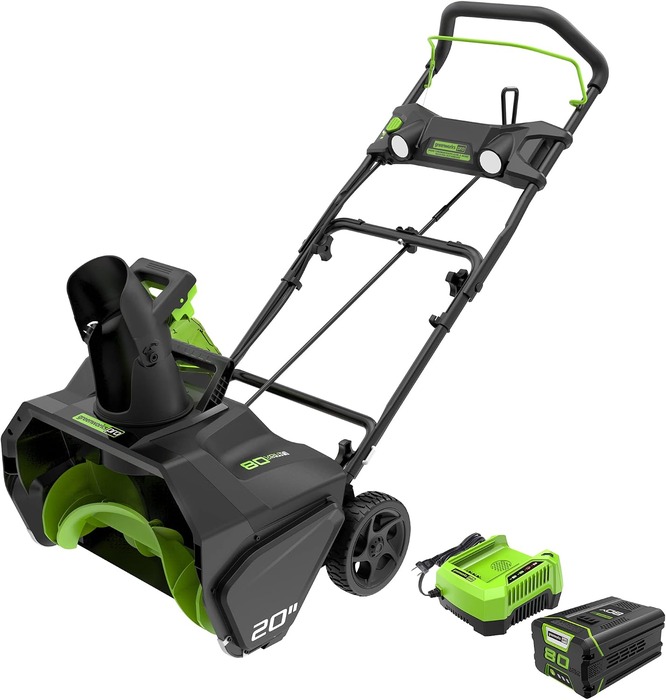
The Greenworks 80V is a straightforward cordless choice for routine clearing on paved driveways, patios, and walkways. Its 20-inch path sits in the useful middle ground between a narrow snow shovel and a bulky two-stage machine. The brushless motor and 180-degree chute cover the core features most readers need for moderate storms.
The verified Amazon package includes one 2.0Ah battery and charger. Greenworks lists clearing depth up to 10 inches, but the modest included battery deserves attention. Battery electric snow blowers consume more energy in deep, wet, or packed snow, so a long driveway may need a larger compatible pack or a charged spare.
Greenworks advises that cold batteries can affect starting and recommends room-temperature storage. Bring the pack indoors after clearing, let it return naturally to an acceptable temperature, and follow the battery and charger manuals before charging. Do not store it where melting snow can soak the terminals.
This model is most attractive for someone already invested in Greenworks 80V tools or clearing a manageable paved area after ordinary storms. The manufacturer does not recommend its single-stage throwers on gravel. For a loose rural lane, move up to a two-stage model approved and adjusted for that surface.
Key Advantages
- 20-inch clearing path in a manageable single-stage body
- Brushless 80V power system
- Battery and charger included
- Strong fit for existing Greenworks 80V tool owners
3. Snow Joe SJ627E — best corded value
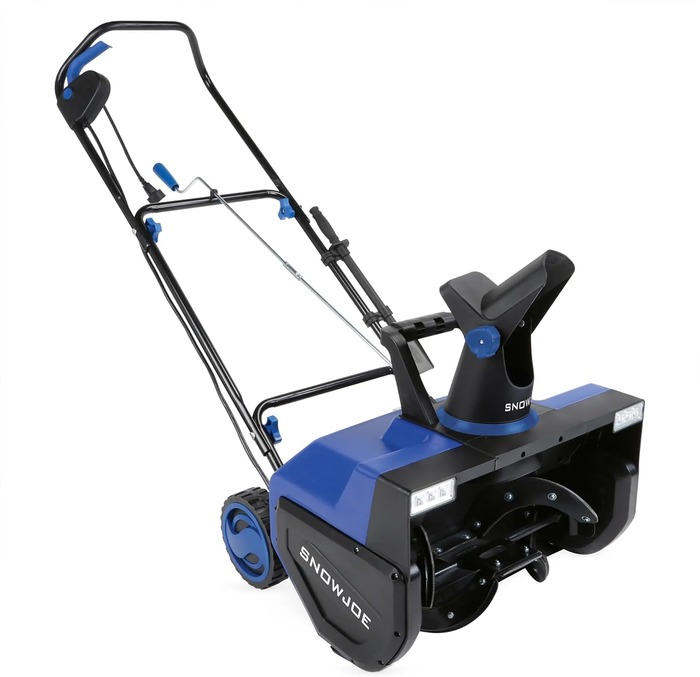
The Snow Joe SJ627E is the corded option for buyers who want a wide clearing path without purchasing or maintaining batteries. Its 15-amp motor drives a 22-inch clearing path with a listed 13-inch intake. The rotating chute and dual lights make it practical for a flat paved driveway near a suitable outdoor outlet.
Snow Joe lists capacity up to 840 pounds per minute and a throwing distance up to 25 feet. Those figures come from the product listing and will vary with snow conditions. The rubber-tipped plastic auger favors pavement and ordinary light-to-moderate snowfall rather than frozen roadside debris or loose gravel.
The biggest limitation is not motor power. It is the cord. Corded electric snow blowers demand a deliberate route that keeps the extension cord behind the operator and away from the intake. Use a cold-weather outdoor cord with the gauge and maximum length specified by the Snow Joe manual. Connect only to the type of protected supply the manual requires, inspect the entire cord before use, and stop immediately if it becomes damaged.
This is the main buying test for corded electric snow blowers: the entire route must be reachable without improvising the electrical setup.
This model makes sense for a compact property where the farthest clearing point remains within one properly sized cord run. It is a poor fit for a long rural driveway, multiple detached outbuildings, or a route that wraps around vehicles and landscaping. Unlimited plug-in runtime is only useful when the cord can reach safely.
Key Advantages
- 22-inch clearing path
- Continuous plug-in operation without battery charging
- 180-degree adjustable chute
- Dual lights for dark winter mornings
4. Earthwise SN74016 — best for walkways and decks
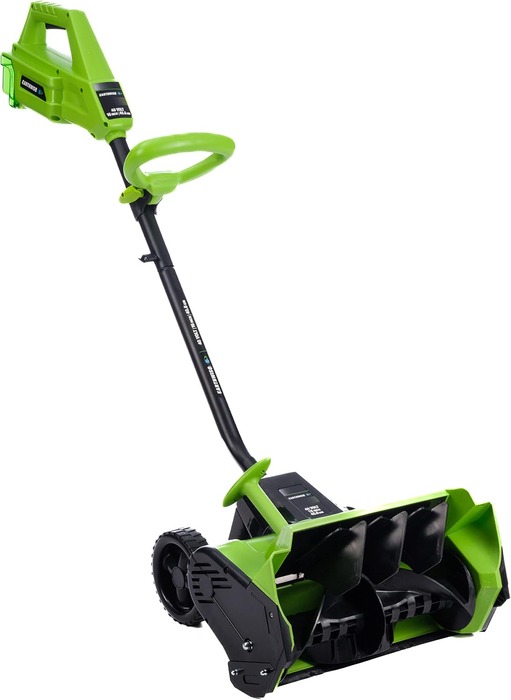
The Earthwise SN74016 fills the gap between a handheld power shovel and full-size electric snow blowers. It has a 16-inch clearing width, rear wheels, a rotating chute, and a 40V brushless motor. The verified package includes a 4Ah battery and charger.
Earthwise lists an eight-inch clearing depth and a throwing distance up to 32 feet. Its narrow width is useful on decks, paths, small patios, and short paved approaches where a 21- or 24-inch machine feels clumsy. The wheels also give it a more familiar pushing position than a basic shovel-style thrower.
Capacity remains the trade-off. This is not the machine for a long driveway after a foot of wet snow. It is better used early, before repeated traffic packs the snow, and in areas small enough to finish on the included battery. Dense plow berms and refrozen piles belong to heavier equipment.
Choose the Earthwise when the real winter problem is access between buildings rather than opening the entire lane. It can also complement a larger two-stage machine: use the large blower on the driveway and the compact tool near doors, decks, animal areas, and narrow gates.
Key Advantages
- Compact 16-inch path for tighter areas
- 40V 4Ah battery and charger included
- Rear wheels and adjustable chute
- Easier storage than full-size electric snow blowers
5. EGO POWER+ SNT2400 — best two-stage machine for demanding properties
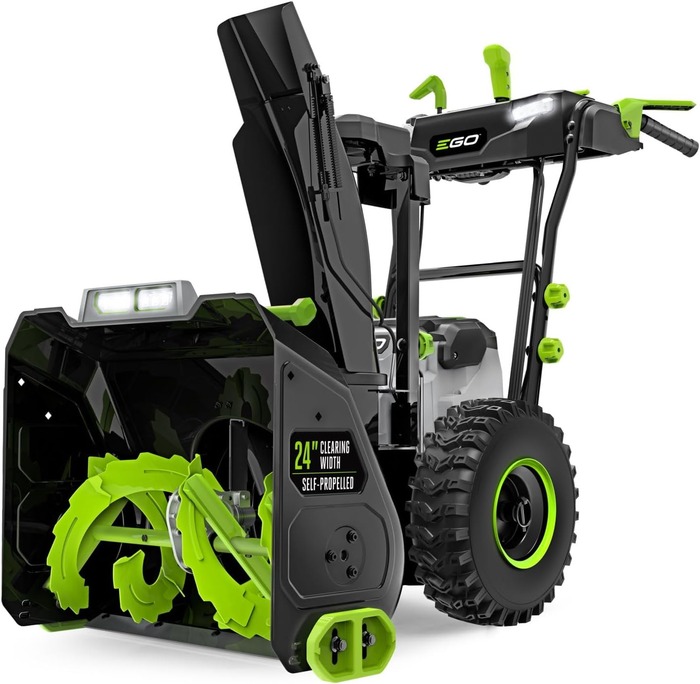
The EGO POWER+ SNT2400 is the heavy-duty pick among these electric snow blowers. Its two-stage design combines a 24-inch clearing width, 20-inch intake, steel auger, separate impeller, and variable-speed self-propulsion. Forward and reverse drive help manage the weight on a long driveway or around a dense roadside berm.
EGO lists a throw distance up to 50 feet and operates the machine with two 56V batteries. The Amazon listing verified for this article is tool-only: batteries and charger are not included. Calculate the full system cost before buying, and confirm the capacity requirements in the current manual. This model makes the most financial sense for buyers who already own suitable EGO packs or genuinely need two-stage capability.
Unlike most single-stage electric snow blowers, the SNT2400 can be adjusted for gravel using its skid shoes and scraper arrangement. Follow the manual carefully and maintain clearance over loose material. No adjustment can make it harmless to people, animals, vehicles, or windows in the discharge direction.
The EGO manual also gives a specific jam-clearing procedure: stop the motor, remove the battery packs, wait for the auger to stop, and use the attached clean-out tool. Never put a hand into the auger or chute. Stored tension can move parts when packed snow finally releases.
Key Advantages
- Two-stage 24-inch design for deeper and heavier snow
- Variable-speed self-propel with forward and reverse
- Adjustable setup for suitable gravel surfaces
- Strong choice for long drives and plow berms
Use electric snow blowers safely
The U.S. Consumer Product Safety Commission warns that people are frequently injured while trying to clear an auger or discharge chute by hand. Never reach inside, even after the motor stops. Switch off the machine, disconnect its cord or remove its batteries, wait for every moving part to stop, and use the supplied clean-out tool or the method specified by the manual.
Inspect the clearing route before starting electric snow blowers. Remove stones, branches, cords, chains, toys, and loose hardware. Keep children, pets, and bystanders away. Aim the chute away from people, roads, vehicles, glass, greenhouses, livestock areas, and anything else that would object to a fast-moving rock.
Turn electric snow blowers off before leaving the operating position, even for a quick obstruction check.
Wear eye protection, winter footwear with dependable traction, close-fitting clothing, and hearing protection when the manual requires it or exposure warrants it. Do not wear scarves, drawstrings, or loose garments that can enter moving parts. Keep stable footing and operate at a pace that lets the machine clear without overloading.
Utah State University Extension recommends traveling up and down an inclined surface rather than across its face and changing direction cautiously. The safest choice still depends on the machine’s manual, the grade, ice, visibility, and operator control. Do not use electric snow blowers on a slope the manufacturer prohibits or on terrain where the machine can pull you off balance.
Clear early when practical. Fresh snow is usually easier to move than a compacted layer topped with freezing rain. In heavy snow, slow down and take narrower passes rather than forcing the full housing into the bank. Stop if the machine vibrates abnormally, strikes an object, damages a cord, or begins behaving differently.
After use, remove the battery or unplug the machine before inspection. Brush away snow without directing water into controls, motor housings, battery compartments, or electrical connections. Let the equipment dry in a location that does not create a puddle around plugs and chargers. Follow the manual for auger inspection, fasteners, skid shoes, scraper bars, lubrication, and off-season storage.
Which electric snow blower should you choose?
The EGO SNT2114 is the strongest all-around recommendation for a paved medium-to-large driveway. Its complete package includes two substantial batteries and a charger, while its steel auger and 21-inch path provide more capability than a compact snow shovel.
Choose the Greenworks 80V for routine paved clearing, especially if compatible Greenworks batteries are already on the property. The Snow Joe SJ627E is the best corded value when the whole route lies near an outlet and safe cord management is realistic. The Earthwise SN74016 is a useful specialist for decks, paths, and tight approaches.
For deep snow, long lanes, plow berms, or an appropriately adjusted gravel driveway, the EGO SNT2400 is the clear step up. Its two-stage system and self-propulsion solve a different problem from lighter electric snow blowers. Remember that the verified listing does not include batteries or a charger.
Buy for the ordinary workload, the worst recurring obstacle, and the surface under the snow. A properly matched modest machine is more useful than an oversized one that is difficult to control, while an undersized snow shovel quickly becomes modern sculpture when the plow berm freezes overnight.
Prepare the rest of the homestead for winter
Battery equipment still depends on a warm, dry charging location and reliable household power. For broader outage planning, compare our guide to the best portable solar panels. Check the snow-blower manufacturer’s charger requirements before connecting any alternate power source; a solar panel is not a direct substitute for the approved charger.
Readers building a more independent electrical setup can also review portable solar panels for off-grid living. Snow-blower batteries store a meaningful amount of energy, so size inverters, power stations, wiring, and charging schedules from real specifications rather than hopeful arithmetic.
When winter pushes more work indoors, our guide to indoor gardening and seed-starting equipment covers tools for keeping the growing season moving while electric snow blowers handle the less botanical side of the weather.
Amazon Disclosure
As an Amazon Associate I earn from qualifying purchases.