
Table of Contents
Grind meat at home without turning the kitchen into a processing plant
Electric meat grinders let you control the cuts, fat ratio, texture, and batch size that go into burgers, sausage, meatloaf, and freezer packages. They are also useful after hunting season or a bulk-meat purchase, when sending every trimmed piece through a food processor becomes slow and messy.
The best electric meat grinders are not the machines with the wildest wattage printed across the box. Head size, rated power, throughput, cooling limits, plate selection, cleaning, and replacement-part support tell you far more. A grinder that handles five pounds once a month has a different job from one expected to process a deer before lunch.
This guide compares five electric meat grinders sold on Amazon, from a compact Cuisinart to a stainless #12 LEM bundle. It also covers meat preparation, sausage accessories, motor claims, sanitation, and safe operation. Raw meat deserves more respect than marketing arithmetic, and so do your fingers.
Decide how much meat you will actually grind
Batch size is the first useful filter for electric meat grinders. A household making a few pounds of burgers or sausage at a time can use a compact countertop model. Someone processing bulk beef, pork, or trimmed venison needs a larger head, stronger drive components, and enough output to finish while the meat remains cold.
Matching electric meat grinders to realistic batch sizes also prevents paying for speed and capacity that will rarely leave the cabinet.
Do not buy solely for one unusually ambitious weekend. Larger electric meat grinders cost more, weigh more, and need more storage and cleaning space. A premium stainless unit is sensible when it will work regularly. For occasional batches, a smaller grinder may be easier to live with and less likely to become a polished shelf ornament.
Small kitchen batches
Compact electric meat grinders suit burger blends, meatloaf, small sausage recipes, and using trim from ordinary cooking. They are easier to move and usually simpler to store. Their smaller trays and lower output require more pauses for loading, trimming, and cooling during large jobs.
These smaller electric meat grinders make the most sense when convenience and easy storage matter more than finishing a large animal quickly.
A compact machine should not be forced to imitate commercial equipment. Cut meat into pieces that fit the feed throat, remove prohibited material, and respect the duty cycle in the manual. If the motor slows or the housing becomes hot, stop rather than pressing harder on the pusher.
Seasonal and bulk processing
A #8 grinder is a common step up for home butchering. Premium #8 electric meat grinders can process medium batches quickly while remaining less bulky than #12 machines. They work well for hunters, small livestock producers, and households that buy meat in large primals.
For many homesteads, #8 electric meat grinders offer the useful middle ground between kitchen appliances and high-output processing equipment.
A #12 head has a larger throat and plate diameter. It can accept larger prepared pieces and move more meat when the motor and auger are designed for the load. That extra capacity helps during long processing days, but it is unnecessary for someone grinding two pounds of chuck for dinner.
What matters when comparing electric meat grinders
Rated power versus peak or locked wattage
Motor numbers are a swamp. Some listings publish rated operating wattage, while others lead with maximum or locked-motor wattage. Locked wattage describes a brief condition when the motor cannot turn. It is not the power the grinder continuously uses while processing meat.
Compare electric meat grinders using rated power, head size, manufacturer-listed throughput, duty cycle, construction, and warranty support. When a listing claims 3,000 watts but says the grinder normally uses 800 to 1,200 watts under load, the lower range describes normal work. The larger number belongs in the research notes, not on a cape.
Horsepower claims also need context. A 0.5-horsepower stainless #8 grinder may outperform a kitchen machine with a larger peak-watt number because the gearbox, auger, knife, plate, cooling, and throat are built for repeat use. One specification cannot describe the whole system.
Grinder head size
The common #8 and #12 labels refer to industry head sizes, not quality grades. A #12 head is larger than a #8 and usually supports higher output. Plate dimensions, throat size, and replacement parts differ, so attachments are not automatically interchangeable.
For most households, a sturdy #8 is a useful middle ground. Choose #12 electric meat grinders when the work involves larger batches, frequent sausage production, or a short processing window. Check the assembled dimensions and weight before volunteering a kitchen cabinet that cannot hold the machine.
Plates, knives, and texture
A coarse plate is useful for a first grind and chunky sausage. A medium plate covers many burger and general-purpose recipes. Fine plates create a tighter texture but require well-trimmed, cold meat and put more resistance on the grinder.
Many electric meat grinders include two or three plates. Confirm their hole sizes rather than relying on coarse, medium, and fine labels alone. A sharp knife and flat plate matter as much as motor power. Dull or incorrectly assembled parts smear fat, strain the motor, and produce a pasty texture.
Well-maintained plates help electric meat grinders cut cleanly instead of squeezing warm meat through a dull edge.
Keep matched knife and plate surfaces in good condition. Follow the manual for assembly direction, storage, sharpening, and replacement. Some parts need a light coat of food-grade oil after cleaning to prevent rust; others are stainless or aluminum and require different care.
Sausage stuffing equipment
Stuffing tubes can make an electric grinder more versatile, but the bundle does not guarantee a pleasant stuffing experience. Look for a stuffing plate or spacer, tube sizes that fit the casings you use, and a low-speed or foot-control option if sausage is a priority.
Grind and season the meat before setting up the stuffer. Keep the mixture cold. A dedicated sausage stuffer is usually easier for frequent, large batches, while grinder attachments are practical for occasional links. Trying to solve every meat-processing job with one machine is how counters acquire permanent collections of mysterious plastic tubes.
Reverse, overload protection, and duty cycle
Reverse can help release a minor clog, but it does not replace proper trimming. Sinew wraps around augers and knives, while pieces that are too large can bridge the feed throat. Stop, unplug, and follow the manual before disassembling any jammed grinder.
Electric meat grinders run more smoothly when connective tissue is trimmed before it reaches the auger.
Circuit breakers and thermal protection guard the motor, though reset procedures vary. One grinder may require a brief reset after an obstruction; another may need a long cooling period. Apply the instructions for the exact model. Do not borrow a cooldown time from an unrelated grinder because the internet placed the manuals next to each other.
Keep meat cold and the work area clean
Electric meat grinders work better when meat is cold and firm. Warm fat smears instead of cutting cleanly, and raw meat warms further while it sits on the counter. Keep the bulk of the batch refrigerated at 40°F or below, bring out manageable amounts, and return them to refrigeration if the process stalls.
Set up electric meat grinders before bringing the first tray of prepared meat out of refrigeration.
Some manuals permit very cold or partially frozen pieces. Others prohibit deeply frozen food. Cut the meat into strips or cubes that fit the feed throat and follow the exact model instructions. Never force a frozen block, bone, or hard object through a grinder based on wattage alone.
Keep raw meat and its juices separate from cooked or ready-to-eat food. The CDC’s food-safety guidance calls for separate boards or plates, clean hands, and washing utensils and surfaces after contact with raw meat. Clean the grinder before use as well as afterward; storage dust and old grease are not secret seasonings.
Use a food thermometer when the ground meat is cooked. USDA guidance sets ground beef and other ground red meats at 160°F, while ground poultry reaches 165°F. Color is not a dependable test. Home grinding gives you ingredient control, not immunity from bacteria that may have been on the original cut.
Top 5 electric meat grinders
1. Cuisinart Electric Meat Grinder – best for small household batches
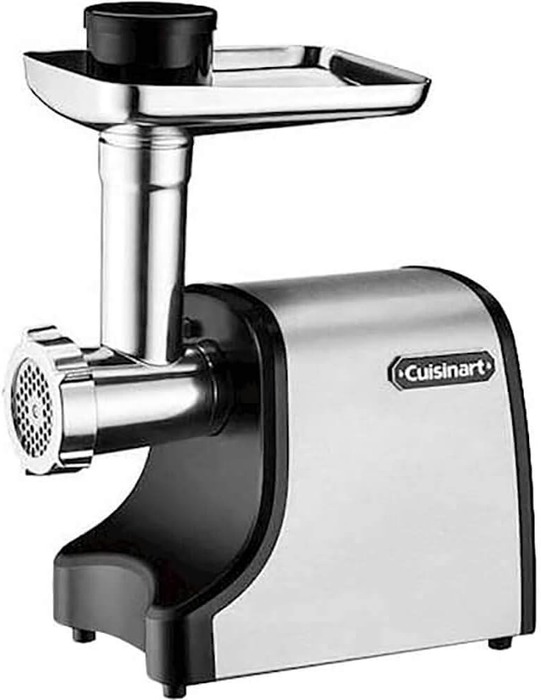
The Cuisinart is the most approachable of these electric meat grinders for routine kitchen use. Its 300-watt motor is listed to grind up to three pounds per minute, enough for burger blends, meatloaf, small sausage recipes, and trim from ordinary meal preparation.
It includes medium and coarse metal cutting plates, two sausage attachments, and reverse. The accessory set is simpler than the STX bundle, but that can be an advantage for someone who wants to grind meat without storing a minor museum of attachments.
The listing does not identify a numbered head size or a continuous duty cycle. Treat it as a household countertop appliance rather than a machine for processing an entire deer in one uninterrupted session. Prepare small cold pieces, let the auger pull them through, and stop if the grinder begins to labor or heat up.
Choose the Cuisinart when storage, simple controls, and manageable batches matter more than maximum output. Buyers expecting regular home-butchering days should move to the LEM BigBite #8 or #12.
Key Advantages
- Listed output up to three pounds per minute
- Medium and coarse plates included
- Two sausage attachments
- Reverse function for minor clogs
2. Sunmile SM-G50 #12 – best value for larger batches
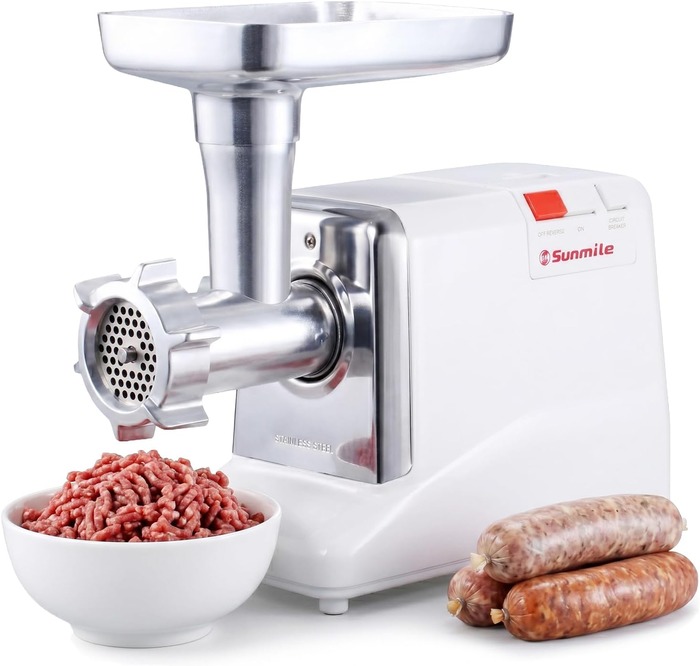
The Sunmile SM-G50 brings a #12 head to the value end of electric meat grinders. Its main listing distinguishes 350 watts of rated power from 1,000 watts of locked maximum power. That distinction matters. This is a 350-watt operating specification, not a continuous 1,000-watt motor.
Sunmile lists output up to 200 pounds per hour with properly prepared meat. Actual output depends on trimming, meat temperature, plate size, and operator pace. The aluminum head has a large tray, while the metal gearbox and circuit breaker suit buyers who want more capacity than a compact kitchen grinder.
The package includes coarse, medium, and fine stainless plates, a stainless knife, pusher, sausage attachment, and reverse control. Three plates provide more texture options than the Cuisinart. The listing says the cutting blade and plates are dishwasher-safe, but the head material needs care. Follow the model manual for every component rather than placing the whole assembly in the dishwasher.
This model fits a household that grinds moderate batches and wants a #12 throat without paying for a premium all-stainless machine. It will still need pauses, proper trimming, cold meat, and the maintenance specified by Sunmile.
Key Advantages
- Larger #12 grinder head
- Three cutting plates for coarse through fine grinds
- Reverse and circuit-breaker protection
- Value-oriented step up from compact kitchen models
3. STX Turboforce 3000 #12 – best accessory and sausage bundle
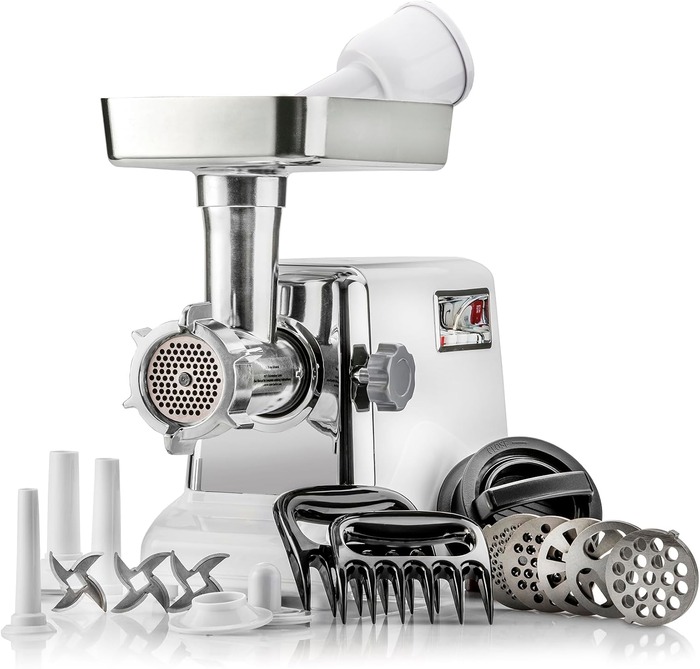
The STX Turboforce 3000 is the bundle pick among these electric meat grinders. It includes three cutting blades, four grinding plates plus a stuffing plate, three stuffing tubes, a kubbe attachment, meat claws, and a burger press. High, low, and reverse settings give sausage makers more control than a single-speed kitchen grinder.
Its wattage needs translation. STX lists 800 to 1,200 watts under load and a 3,000-watt locked-motor maximum. Another technical field on the Amazon page says 1,800 watts. The article does not treat 3,000 as continuous power, and buyers should use the manufacturer’s operating documentation rather than comparing the biggest printed number.
The main product bullet lists 180 to 240 pounds per hour when meat is properly prepared. Other promotional copy on the page makes a higher claim. The lower, qualified range is the more responsible figure to record, though no listing estimate guarantees output in a home kitchen.
STX specifically says this model is for home use and should not grind bones, tendons, nuts, vegetables, or fruit. Its value lies in the included plates and stuffing equipment, not pretending it is a commercial bone mill. Choose it when sausage and varied grind textures matter more than stainless construction.
Key Advantages
- #12 head with multiple speed settings and reverse
- Four grinding plates plus a stuffing plate
- Three sausage-tube sizes
- Broad accessory bundle for varied home processing
4. LEM BigBite #8 – best premium grinder for repeat home use
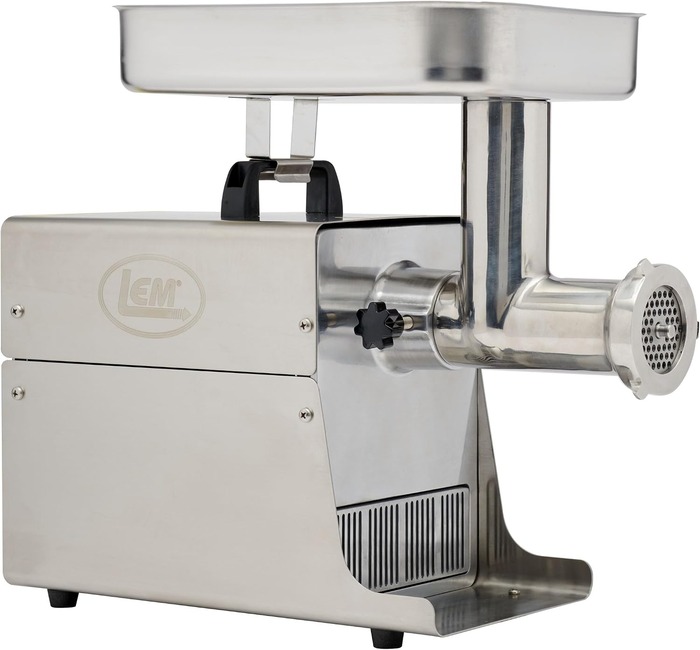
The LEM BigBite #8 is the strongest all-around recommendation for readers who use electric meat grinders regularly. It combines a stainless build with a 0.5-horsepower motor and a #8 head. LEM’s main listing says it processes about seven pounds per minute, which is enough capacity for repeat home-butchering sessions without the size of a #12 machine.
The package includes three plates, a knife, stomper, and sausage tubes. Its permanently lubricated motor reduces routine motor maintenance, while the grinder disassembles for cleaning. The listing also describes noise-dampening construction and a five-year factory warranty.
Output claims still depend on preparation. Cold, well-trimmed strips move more predictably than warm chunks tangled with connective tissue. The listing says this grinder is not for bones. Use the stomper, never a hand, and allow the auger to pull meat rather than packing the throat under body weight.
Choose the BigBite #8 when grinding is a regular part of the household’s food work and long-term build quality matters. The #12 bundle is faster and adds foot control, but it is heavier, larger, and more machine than many kitchens need.
Key Advantages
- Stainless #8 construction
- 0.5-horsepower motor
- Listed output of about seven pounds per minute
- Five-year factory warranty listed by LEM
5. LEM BigBite #12 with foot switch – best for high-volume home processing
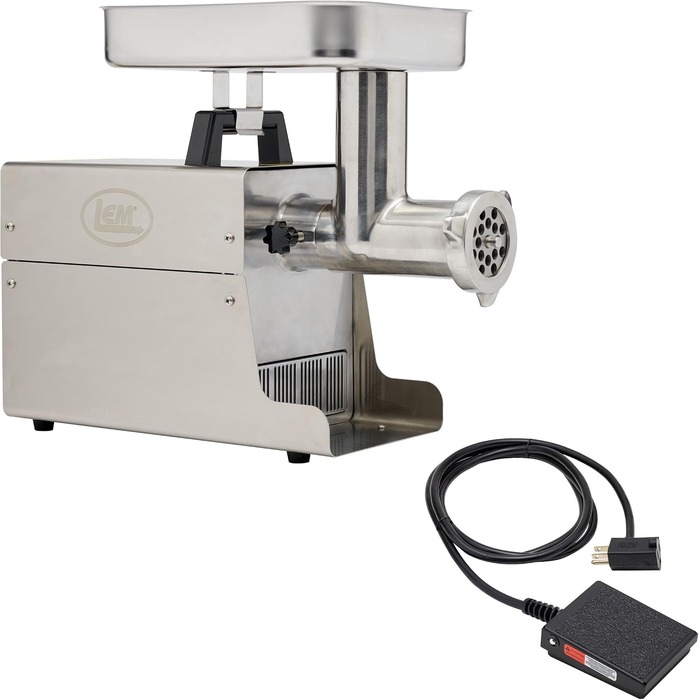
The LEM BigBite #12 is the high-output choice among these electric meat grinders. Its 0.75-horsepower motor and #12 stainless head are listed to process up to 11 pounds per minute. That capacity suits large game, bulk-meat purchases, and households that need to finish a large chilled batch efficiently.
This Amazon bundle includes a foot switch, three plates, knife, stomper, stuffing tubes, and accessory drawer. Foot control can free both hands for stuffing or filling bags, provided the grinder is set up exactly as the manufacturer directs. The listing gives the grinder a five-year factory warranty and the foot switch a separate one-year warranty.
The product page makes a claim about raw chicken bones. This article does not recommend bone grinding. Model restrictions vary, manuals change, and fragments can damage equipment or create food-safety problems. Use only material expressly permitted by the current manual for the exact model and configuration.
The #12 makes sense when output is the bottleneck. It is a poor value for someone who grinds a few pounds at a time, and its weight and footprint deserve a permanent storage plan. Serious equipment that lives under a stack of mixing bowls soon becomes theoretical equipment.
Key Advantages
- Stainless #12 head and 0.75-horsepower motor
- Listed output up to 11 pounds per minute
- Foot switch included for compatible hands-free workflows
- Built for medium-to-large home-processing batches
Use electric meat grinders without sacrificing food safety
Start with safe thawing. USDA recognizes refrigerator, cold-water, and microwave thawing methods. Do not thaw raw meat on the counter. Meat thawed in cold water or a microwave needs the handling and cooking steps specified by USDA, and the cold-water method requires leak-proof packaging and regular water changes.
Safe thawing matters because electric meat grinders can distribute surface contamination throughout a batch of ground meat.
Trim the meat while it is cold. Remove hard objects, bone, and heavy sinew unless the exact grinder manual says otherwise. Keep prepared cubes in the refrigerator while electric meat grinders are assembled. If the fat begins to smear or the meat softens, return the batch and approved removable parts to refrigeration. Never place the motor housing in a refrigerator or freezer.
Use only the supplied stomper. Fingers, wooden spoons, knives, and improvised plungers do not belong in the throat. If the auger stops, switch the grinder off, unplug it, wait for moving parts to stop, and follow the manual. Reverse may release a minor clog, but it is not permission to reach into the machine.
Disassemble electric meat grinders after unplugging them. Wash food-contact parts in warm or hot soapy water according to the manual, rinse them, and dry them completely. Dishwasher compatibility varies. Aluminum can discolor or corrode, and some knives or plates can rust if left damp.
University of Minnesota Extension’s sanitation guidance separates cleaning from sanitizing. Remove debris, wash, rinse, then use a food-contact sanitizer at its labeled concentration and contact time. Confirm that the sanitizer is compatible with the grinder’s materials. More chemical is not more sanitary if it damages the equipment or leaves an unsafe residue.
Inspect the knife, plate, auger, retaining ring, cord, and seals during cleanup. Dry and store parts as the manufacturer directs. A thin coating of food-grade oil may be appropriate for rust-prone steel components if the manual calls for it. Record which knife and plate have worn together if the manufacturer recommends keeping them matched.
Store electric meat grinders where cleaned parts remain dry and protected from dust and pests.
Which electric meat grinder should you buy?
The LEM BigBite #8 is the best overall choice for repeat home butchering. It offers meaningful output, stainless construction, a manageable #8 format, and enough included equipment for grinding and occasional sausage work.
Among these electric meat grinders, it strikes the best balance between household size and processing-day capacity.
The Cuisinart is better for small kitchen batches and buyers who do not need a dedicated processing machine. The Sunmile SM-G50 brings #12 capacity at a lower equipment tier, while the STX Turboforce earns its place through plates, stuffing tubes, speed options, and accessories.
Choose the LEM BigBite #12 only when large batches justify its cost, footprint, and output. It is the useful brute of the group, especially when the included foot switch fits the workflow. For a household grinding five pounds of burger, it is rather like buying a tractor to move a flowerpot.
Whatever machine you choose, cold preparation and sanitation matter more than a dramatic wattage label. Electric meat grinders can make food processing faster and more flexible, but they cannot repair warm meat, dull parts, poor trimming, or unsafe handling.
Preserve ground meat after processing
Portion finished meat promptly and return it to refrigeration or freezing. Our guide to the best vacuum sealers for long-term food storage covers machines for packaging freezer portions. Vacuum sealing reduces air exposure; it does not replace cold storage, sanitation, or safe cooking temperatures.
Clean electric meat grinders before packaging begins so raw residue does not remain on the counter while finished portions are handled.
For shelf-stable preservation, use tested recipes and approved equipment rather than inventing a canning process around the day’s grind. Our guide to pressure canners for home food preservation explains the equipment side. Follow current USDA or extension processing instructions for the exact meat product, jar size, method, and altitude.
A grinder also depends on reliable electricity during processing and cleanup. Readers planning broader resilience can compare the best portable solar panels, but check the grinder’s actual electrical requirements and the power station or inverter specifications. A panel does not plug directly into most electric meat grinders, and hopeful wiring remains a poor food-preservation technique.
Amazon Disclosure
As an Amazon Associate I earn from qualifying purchases.